Monday, February 10, 2014

10 Suggestions for a Winning SBIR Proposal

Over the last 10 years or so, I have reviewed grants for a number of federal agencies, notably NSF, USDA, and FDA.  Most recently, I have been participating on various review panels for NSF Small Business Innovation Research (SBIR) funding about once or twice a year.  If you are not familiar with SBIR grants, they are awarded by nearly every federal funding agency to small businesses (fewer than 500 employees) for innovative technical concepts to help bridge the gap from proof-of-concept to commercialization.  Often there is a university-based partner where the idea originated or who is helping with a particular aspect of the research.

It is beyond the scope of this post to discuss all the nuances of the SBIR program.  However, my experience reviewing scores of proposals has taught me a few lessons about what is likely to get, or not get, funded.  Most of the proposals I have looked at have been Phase I (6 months and $150,000) in the topical areas of chemical and biological sensors, but I think many of these lessons will apply to other proposals as well.   If you work for a small business soliciting funding in this program, or you are an academic researcher looking to kick-off a new business venture with an investment from Uncle Sam, pay close attention.
  1. Include some preliminary data, any data, even if it is not yours, in the proposal.  I know that preliminary data is downplayed in SBIR proposals, compared to standard NSF or NIH grants; however, it is important to present some information to show that your concept is not just a cocktail napkin doodle.  By the way, simulations can augment experimental data but cannot replace it.
  2. Provide a detailed description of the device, its materials, and how it will be fabricated.  Every sensor has both receptor (how the target analyte is picked out of the sample) and transducer (how this recognition is converted to a usable signal) components.  Make sure you adequately describe each, even if you are using standard receptors such as antibodies.
  3. Make sure the fabrication has a pathway to manufacturing.  If you have an elegant concept that can only be demonstrated in the laboratory, you are not ready to submit an SBIR proposal.  There must be a product that comes out of this sometime down the road.
  4. Show a basic understanding of the characteristics and parameters of importance in your application area.  If you are going to claim that your device will beat all the competition by orders of magnitude in sensitivity, you must also address the effects on selectivity.
  5. Write your research plan with sufficient detail.  Describe how you will do the experiments, what are the samples and how many, how you will collect and analyze the data, what are the expected outcomes, and what alternative approaches exist in case of problems.  Also, in my opinion, developing your plan for Phase II should not be part of your Phase I effort.
  6. Create a research team with diverse expertise.  If you are an electrical engineer who has developed a new sensing widget which you plan to use to detect cancer biomarkers, you should have someone on your team with experience in biochemistry or clinical medicine.
  7. Have letters of support from potential collaborators, commercial partners, and customers. The more letters you have indicating what a great idea this is, how much they look forward to working with you, and what a need this fills in their specific market, the better.
  8. Make the figures big enough to read the axis labels.  This may be obvious, but you would be surprised by how many people try to save space with tiny figures and then leave some of the 15 page limit unfilled.
  9. Don’t spend so much ink on commercialization plans.  Maybe other reviewers look at this more carefully than I do, but for me it is more important to read the details of your technical description and research plan so that I am satisfied of your capability to do the work.  If a reviewer is not convinced of your technical competence, it will not matter how much revenue you plan to earn.
  10. Create a budget and time commitment that is reasonable for the limited funding and project length.  It is good to be ambitious, but most reviewers are also researchers who know when you have bitten off more than you can chew.  Also, while you would like to keep all the funding to pay your own salary, it is much more believable if you diversify the budget to pay a team of researchers with specific roles, rather than putting the entire burden on one individual.
This top-ten list is certainly not exhaustive, and you should also follow any specific suggestions of the agency or program to which you are applying.  Nevertheless, I recommend that you follow these guidelines when applying for SBIR grants. While it’s no guarantee that you will receive funding, it’s a good place to start.

Friday, January 3, 2014

2013: A Year in Review

Happy New Year to all.  As is typical, this is the time in the calendrical cycle when we look forward to a brand new and unsullied 12 months in front of us which allows us to make resolutions (or revolutions if you have seen the latest ATT TV ad) about changes in our habits and behavior.  It is also the time when we look back at the year just past, to recognize the achievements that help us believe that the human species is making progress.

The world of nanotechnology is no exception, and a good compendium of popular (not necessarily synonymous with significant) news stories from 2013 can be found at Nanowerk.

Here at Georgia Tech, and specifically at the Institute for Electronics and Nanotechnology (IEN), we witnessed a number of noteworthy developments and achievements.  In no particular order, here is the best of IEN 2013:
  1. Significant new funding and investment was obtained by IEN user companies Suniva, Lumense, and Axion Biosystems.  Additionally, new companies Immucor, Clearside Biomedical, Hoowaki and Clopay Plastic Products, among others, joined the IEN user community.
  2. IEN Senior Research Engineer Devin Brown won the Grand Prize in the EIPBN 2013 photomicrograph contest.
    Blue Sun Flower, Devin Brown
  3. IEN held its First Annual USER (User Science and Engineering Review) Day, highlighting the research achievements of our more than 700 users.
  4. The GT-NNIN Education and Outreach Office was nominated as STEM Education Award Finalist by the Technology Association of Georgia.
  5. The IEN got company among the Georgia Tech Interdisciplinary Research Institutes (IRI) with the birth of the Institute for Materials (IMAT) and the Institute for Robotics and Intelligent Machines (IRIM).
  6. IEN co-hosted the Southeast Regional Energy Symposium (SERES).  See yours truly examining one of the student demonstrations.
  7. Significant progress was made on construction in the Marcus Nanotechnology Building, with completion of two laboratory floors (devices and biomedical) and the cleanroom staff office, initial work on the imaging and microscopy suite, and design of the final lab floor (materials).  The IEN's physical space was accompanied by a new virtual presence as the IEN website was launched.
  8. IEN initiated a Seed Grant Competition.  This program was created to identify new, currently-unfunded research ideas that require student cleanroom access to generate preliminary data necessary to pursue other funding avenues.  I promise a fuller blog post about this program later.
  9. Research progress was made by numerous IEN faculty members, including Dennis Hess, Younan Xia, ZL Wang, Todd Sulchek, Jud Ready, Ken Sandhage, Andrei Fedorov, and Alan Doolittle, with a spate of reports appearing in October and November.  You can see most of these in posts on our Facebook or LinkedIn pages.
  10. The IEN celebrated the long and prestigious career of Prof. James Meindl (MiRC and NRC Director) who retired in June.  We also witnessed the departure of IEN founding director Prof. Mark Allen as he moved to the University of Pennsylvania.  Finally, we welcomed Prof. Oliver Brand who took over as Interim Director while a national search for a new IEN Executive Director takes place.
Here’s to hoping that 2014 brings us all continued progress, success and happiness.

Wednesday, December 11, 2013

Borrowed Thoughts on Research Funding

At the end of my previous post, I hinted that I have been thinking lately about funding of research and development activities, particularly government funding of basic research.  This thought was catalyzed by a recent article in Science, What's So Special About Science (And How Much Should We Spend on It?), an address to the 2013 AAAS Annual Meeting by William H. Press.  Although it is a bit long and technical from an economic perspective, I think this is one of the best written and most logical statements for federal support of scientific research that I have ever read. The foundational idea, sustained by the evidence, is that scientific research is supported by the public both because it contributes to “intellectual richness” and has tangible economic benefits.  Is this changing?  Will this support continue?

Because I think it is important for everyone to understand the article’s arguments, I provide below an abridged version.  But I urge you to read the original; it is worth it (and it has figures).
  1. United States GDP/capita has increased exponentially for more than 130 years, and this country is among the leaders in R&D spending as a percentage of GDP (~3%).  But does R&D spending lead to wealth or does a nation’s wealth result in more R&D spending simply because it is available? Let’s take a closer look at the economics.
  2. Exponential GDP growth is due to a positive feedback mechanism (so say Nobel Prize winning economists).
  3. Only capital, including intellectual capital and technology, can produce exponential economic growth.
  4. A key concept to understanding the benefits of research is appropriability, which can be defined as how well returns accrue to investors.  That is, do investors in research get a payback for their invested money?  The answer for basic research is not very good.  While the returns can be substantial, because of modern dissemination of ideas these often do not come back to the original investor but are more globally distributed.
  5. Hence, incentive for private investment in basic research is diminished.  So, public investment must fulfill this role, and it generally does.
  6. Over the last 50 years, however, the US government’s 2/3 share (in the early 1960s) of research funding has decreased to 1/3 with the opposite seen for industry funding.  But this increased industry funding is more applied, and thus more appropriable, for faster return on investment.
  7. From 1990-2007, industry’s basic research spending was stagnant and this has been the case for government spending since 2003, in constant dollars.
  8. Basic research is not growing with the economy therefore the feedback mechanism (see #2 and #3) is broken; 10 years of neglect need to be reversed.  This will also lead to a global effect with no country willing to invest in basic research – the “tragedy of the commons” – because everyone will believe they can benefit from the work of others.  According to Press:
“The current situation is dangerous. Short-term actions in a time of budget crisis and financial austerity might become the triggers of long-term underinvestment in the ultimate fuel of economic growth, basic research in science.”
So, what is the solution to this problem?
  1.  National and state government policies must change to increase appropriability and return on investment in basic research.  One such approach may be university and other infrastructure-based research hubs that are designed to keep commercialization efforts more local and regional.
  2. History demonstrates that technical advances due to basic research are not rare events, but occur frequently, and with significant payoff, and this is intuitively understood by the public.  We, the public, need to convince our government, therefore, that patient, sustained, and consistent investment is required. 
It is only through education, outreach, and the democratic process that scientists and engineers, with the help of the public, can cause governments to act.

As Press states so eloquently:
“Through communication with the public, we must continue to provide the evidence that may justify those beliefs…as individuals, we must seize every opportunity to demonstrate that what we do is altruistic and idealistic and that it is also economically vital.  Our message is that science is a single, unified, long-term enterprise in which basic science discoveries, and research accomplishments of applied science and engineering, are things to be admired in their own right that also, often unpredictably, lead to better jobs and better lives, new products and new industries.”
Now who can argue with that?

Tuesday, November 26, 2013

Open Access (and Prof. Mostafa El-Sayed)

This is not exactly a “my dog ate my homework” excuse, but it is close.  I had intended to write about the events related to Georgia Tech’s Open Access Week closer to the time of their occurrence, but something else got in the way.

That something was my work in helping to organize and then attend the Southeastern Regional Meeting of the American Chemical Society (SERMACS) which was held in Atlanta Nov. 12-16. The theme of the meeting was “Building Chemical Bonds”, and it highlighted, through a wide variety of symposia, workshops, and events, the benefits of collaborative relationships between academia, industry and government.  While I spent a good portion of my time at the conference helping to support the IEN exhibit booth, I did have a chance to attend a wonderful 1.5 day symposium organized to celebrate the 80th birthday of nanotechnology luminary Prof. Mostafa El-Sayed (Georgia Tech).  Peppered with old photos and reminiscences of Prof. El-Sayed’s prolific career by colleagues, friends and former students, the symposium also highlighted the influence he has had on the field by the rich diversity of technical topics presented by the distinguished group of speakers including Mark Ratner, Chad Mirkin, Naomi Halas, Catherine Murphy, Jeff Zink, and Younan Xia, to name a few.  His technical leadership in nanoscale science, nanomedicine, and spectroscopy has resulted in his group’s more than 600 publications consistently among the most cited in chemistry. In addition, nearly every speaker commented on Prof. El-Sayed’s kindness and generous nature, and many of the shared photos depicted group holiday meals celebrated at the El-Sayed household.

This post is really about the Open Access Week celebrated at Georgia Tech the week of Oct. 21-25.  While typically centered around events that contribute to a discussion of journal publications and the growing movement to reduce the economic burdens for universities and individual researchers to mine their rich content, this year the Georgia Tech Library also partnered with the Institute for Electronics and Nanotechnology to highlight another aspect of open access, that of access to research resources.  The IEN is a natural fit for this conversation, as our open, shared user facilities are designed to foster exactly the same type of freedom of access to research infrastructure as is analogous to that of research results and publications.  In particular, through our Nano@Tech program, the Library and IEN co-hosted both an informational seminar and hands-on workshop on the topic of nanoHUB.  NanoHUB, a program of the NSF-funded Network for Computational Nanotechnology and run by Purdue University, is an “online gateway to simulation, research, collaboration and teaching in the nano-sciences” with nearly 300,000 world-wide users of the site.

Click on the map to see the growth in nanoHUB global users.
 
The seminar titled “Mythbusting Scientific Knowledge Transfer with nanoHUB.org: Collaborative Research and Dissemination with Quantifiable Impact on Research and Education” was an overview of nanoHUB.org’s many offerings presented from the viewpoint of a user, Dr. Tim Fisher from Purdue’s School of Mechanical Engineering and the Birck Nanotechnology Center.  This was followed in the afternoon by a workshop facilitated by Dr. Tanya Faltens, where Georgia Tech researchers were given a guided tour of some of the site’s capabilities.  An article in Nature Nanotechnology, entitled "Learning and research in the cloud" by nanoHUB Director Gerhard Klimeck and colleagues that appeared just after Open Access Week, makes the point that this “cyberinfrasturcture” is an ideal environment to meld the dual academic roles of research and education.  As the article concludes:
“nanoHUB offers an easily accessible learning infrastructure that connects teachers and students with the research community. Such cyberenvironments can act as a translational agent that helps transfer new knowledge and methods to learners and researchers in ways that were not possible before.”
It occurred to me as I was finishing up this blog post that both items I have written about, the El-Sayed Symposium at SERMACS and nanoHUB, fundamentally illustrate the same point.  The advancement of science and technology is no longer a solitary pursuit, but rather a very social interaction with all parties dedicated to a common objective of advancing our knowledge of how the universe operates and improving the lot of humankind. This is a lofty goal which can be difficult to achieve in an age where rapid return on investment is a necessity for economic support of the research enterprise; but that is the subject of a different post.

Friday, November 1, 2013

Nano on the Shelf and in our Stomachs

Whenever I speak about nanotechnology, and the work that goes on at the IEN, to students or public audiences, I always discuss the surge in commercial products that contain some nanoscale component over the last decade or so.  I mention that one of my favorite websites, one that is very accessible to a lay person, is the Project on Emerging Technologies.  I have also written on this blog several times about this website and the hope and hype of nanotechnology commercialization efforts.  (As an aside, I was first introduced to the Project website when I came across the instructive and entertaining video “The Twinkie Guide to Nanotechnology” created by then Project director Andrew Maynard.  Check it out for an interesting introduction to this topic.)

One of the more useful aspects of the Project website is that it hosts a database of nanotechnology-related consumer products which had grown to >1300 items when it was last updated.  However, and I can sympathize as one who has recently become active again after a quiet period, the updates stopped in 2010.  Now, the news comes out of the Wilson Center and its new collaborator the Virginia Tech Center for Sustainable Nanotechnology, that the wheels have started turning again on the Consumer Products Inventory (CPI).  The latest version of the inventory lists >1600 products, a 24% increase since 2010.  In addition to a new design that makes it easier to browse, search, and navigate the site, interested scientists and citizens can now register as crowdsource participants, contributing data about the products and the nanoparticle components they contain.  As described on the site:
“By crowdsourcing expertise our goal is to create a 'living' inventory for the exchange of accurate information on nano¬ enabled consumer products. Registered users are encouraged to submit relevant data pertaining to nanoparticle function, location, properties, potential exposure pathways, toxicity and life cycle assessment. Registered users can update product information and add new products.”
As in the past, the vast majority of products, nearly half of those in the inventory, are in the health and fitness category, although the largest percentage increase of products are in the food and beverage group.  Silver is still the most common nano-material, with titanium making a significant jump, nearly tripling in the number of products.  It should come as no surprise that there is a correlation here, with most of the food products containing nanoscale titanium (as titanium dioxide).  The purpose of this ingredient is for the whitening of products (without naming names) such as cream-filled sandwich cookies, cream cheese from a city in the Northeast, and breath mints that jiggle in your pocket.  I am not a food chemist (and do not even play one on TV), so I cannot offer expert advice here.  I will note that most of the producers of these products do not tout this nanotechnology ingredient in their marketing efforts.  You will also find, if you do a quick Google search, that there is a small cottage industry of conspiracy advocates that fears the worst.  On the other hand, numerous studies have found no harmful effects from typical exposure through food ingestion.


As in all aspects of commercial life, caveat emptor.  At least now there is an updated inventory if you want to see what nanotechnology-enhanced products there are to purchase, or not.

Last minute update:  Twinkies?  Yep, they were added to the inventory earlier this year as well.

Thursday, October 24, 2013

Awake

You remember the story of Rip Van Winkle, by Washington Irving, right?  An indolent man, Rip awakes after a 20 year slumber, thereby missing out on the Revolutionary War in upstate New York.  Well, this blog is somewhat like that.

Life size bronze of Rip Van Winkle sculpted by Richard Masloski, copyright 2000.

I have not written a blog post for Room at the Bottom for nearly 3 years.  I could go on and on about the reasons (indolence being one of them), but the end result is that time has passed while this accounting of my observations of nanotechnology and Georgia Tech has stood still.  While I am ready to begin my musings once again, I have the unenviable task of updating the site as well as all (okay, some) of what has transpired during my time away.

When I last wrote in this space, the operational unit for nanoscale fabrication and characterization at Georgia Tech was the Nanotechnology Research Center (NRC).  In early 2011, a new Interdisciplinary Research Institute (IRI) was created at Tech – the Institute for Electronics and Nanotechnology (IEN) - which consolidates much of the research in this area and several existing research centers into a common organization.  This IRI follows on the model set earlier by the Institute for Bioengineering and Bioscience (IBB) and is the new paradigm for similar research topic-themed institutes at Georgia Tech. The founding Executive Director was Prof. Mark Allen, who recently announced his move to Penn; he has been replaced on an interim basis by Prof. Oliver Brand while a national search for a new IEN Director is conducted.

You can find out more about IEN at our new website, and continue to get timely updates and announcements through our Facebook page and LinkedIn group.  You can also come meet us in person at some upcoming conferences: IEEE Sensors (Baltimore, Nov. 4-6), SERMACS (Atlanta, Nov. 13-16), and IEEE MEMS (San Francisco, Jan. 26-30).  Of course, it is my intent that this blog will once again be a source for news, opinion, commentary, review, and gossip about items of interest to our community.  Stay tuned.

Friday, December 10, 2010

Nanobots: Truth is “Cooler” than Fiction

I am often proven wrong (just ask my wife), but usually not so quickly.  This time it took only 4 days.

On Tuesday, at the request of the NRC Education and Outreach Office’s Joyce Palmer, I spoke to a group of students who make up the Rockin' Robots, a FIRST LEGO League team from Faith Lutheran School in Marietta.  In particular, these elementary students are tasked, through the 2010 Body Forward Challenge, with exploring “the cutting-edge world of Biomedical Engineering to discover innovative ways to repair injuries, overcome genetic predispositions, and maximize the body's potential, with the intended purpose of leading happier and healthier lives.”  Joyce wanted to know if I could address some of their questions related to bionanotechnology and provide a dose of reality.  I prepared myself to dash water on their images of nanorobots coursing through the bloodstream fixing problems and keeping us fit and healthy.  I remember thinking the movie Fantastic Voyage (based on the Isaac Asimov novel) was really cool at their age (and it had Raquel Welch in it).

I listened carefully, and with growing amazement, as the student leader of the team described their plan to use synthetic sandcastle worm glue to improve the healing of broken bones in the body.  This concept is based on the research of Russell Stewart (University of Utah).  He went on to explain that they would target the site of the breakage by coupling the delivery system with antibodies to osteoprotegerin, which is produced in the body to stimulate bone growth and increase bone density.  Finally, a liposome delivery system was chosen for the project.  My preconceived notions took another hit when I read on the team’s website (Osteo Repairo, a play on a Hogwarts spell) that they “first thought we would use nanobots to get there because they are cool and really small but then we kicked things around …and asked what could bond with the antibodies and he [Team Coach Dr. Shawn Jobe] explained about liposomes. Some of us have never heard of liposomes. Zach really thought they were awesome and Ethan built a model of one.  After that we were all in with liposomes as a delivery method.”

Clearly, these students did not require me to lecture them on the difference between the promises of nanotechnology and the hype that is often used in both fiction and marketing.  They were well-grounded in the facts and only needed me to clarify some of the subtleties (although I confessed to them that I am not an expert in the specific areas of their research).  We discussed options for getting the treatment into the bloodstream (including microneedle patches), and I cautioned them that antibodies can have non-specific binding that could lead to unwanted delivery consequences.

Finally, my crow-eating was complete when I read this morning about a new drug delivery concept from the Laboratory for Nanobioelectronics at UC San Diego that involves “the directed delivery of common polymeric and liposomal drug carriers using catalytic nanomotors.”  In particular, the futuristic image of an autonomous nanomachine, the specific image I tried to minimize in my discussion with the students, is now one step closer to reality.  As lead researcher Joseph Wang puts it: “We are all motivated towards realizing the vision of the 1966 movie Fantastic Voyage vision and by the potential to enhance medical treatment.”

I guess the Rockin’ Robots are not the only ones who think nanobots are “cool and really small.”

Friday, December 3, 2010

It's All Chemistry

I attended the Georgia Tech School of Mechanical Engineering's Gegenheimer Lecture on Innovation yesterday.  While the speaker, GT alumna Prof. Robin Murphy (Texas A&M), presented an interesting discussion on the use of robots in search and rescue, with considerable attention paid to the interaction between humans and robots, it was the student’s question I happened to hear on my way out that really attracted my attention. This student wanted to know, in the spirit of innovation, if there was something the speaker believed but that others may not.

I found this a thought-provoking inquiry, and spent the next several moments during my walk back to my office considering my own beliefs (scientifically speaking) and how they mesh within the larger scholarly community.  In particular, I thought back about 10 years, during the early days of the current nanotechnology revolution and of my impression at that time, with a soupcon of righteous indignation as a card-carrying chemist, that this “new” technology is nothing more than chemistry with a fancy new name.  While I have since softened this stance as I gain more knowledge of the breadth of this enterprise, fundamentally I still believe that chemistry contains the elemental principles behind most of nanoscience and nanoengineering.  Particles, materials, surfaces, and even devices are all manifestations of inter-atomic and inter-molecular forces (the domain of chemistry) that take on added importance when the materials themselves are on the same scale as their constituent components.  The reason a gecko can walk on the ceiling is because the combined van der Waals forces between the millions of nano-sized spatulae on its feet and the ceiling surface are greater than the opposing force of gravity.  This is the take-home message I drill into students: There is nothing scientifically new that occurs on the nano-scale, but rather the same interactions and forces we have known about since the advent of organized science take on added magnitude compared to the macro-scale forces.

The centrality of chemistry in our everyday lives was even used by my American Chemical Society colleague Don Hicks when he created a viral marketing campaign (see the bumper magnet below) a few years ago to spur public recognition of the value of our science.


All of this makes the news article I read earlier this week even more grating.  It seems a research team from the University of Missouri has developed a new process for gold nanoparticle synthesis that avoids the toxic reagents normally used in such reactions.  Instead, the researchers discovered that phytochemicals found in cinnamon (yes, that spice that is omnipresent in our kitchens this time of year) can act as effective reducing agents for turning gold salts into gold nanoparticles.  This green process is wonderful and I applaud their ingenuity.  However I was taken aback by this assessment:  "The procedure we have developed is non-toxic," Kannan said. "No chemicals are used in the generation of gold nanoparticles, except gold salts. It is a true 'green' process." 

This reminded me of the challenge by the Royal Society of Chemistry a few years ago for anyone to produce a material that is “chemical-free.”  Needless to say, no one has claimed the prize.

Wednesday, October 6, 2010

A Milestone in Nanotechnology History

I know that I have not posted any material lately, as I have been concentrating on the NRC's other modes of communication (Facebook, LinkedIn, and our Newsletter), but I could not pass up an opportunity to reference one of the major milestones in the short history of nanotechnology: the 25 year anniversary of the discovery of buckminsterfullerene at Rice University by Smalley, Curl, and Kroto.

Building blocks of nanotechnology to be named National Historic Chemical Landmark

There is a particular resonance for achievement of this status this year, as the base material of the fullerenes (carbon) is the same as that of graphene, which was just recognized with awarding of the Nobel Prize to Geim and Novoselov

On a personal note, when I was visiting potential graduate schools in 1984, I happened to be at Harvard University on the same day as a seminar by Prof. Rick Smalley.  I cannot recall what the topic of the seminar was (perhaps early experiments with buckyballs), but I do remember the Harvard faculty I met with encouraging me to attend because Smalley was "doing great things."  I guess the 1996 Nobel Prize committee agreed.

Tuesday, July 13, 2010

Can You Hear Me Now?

Interested in the goings on of the Nanotechnology Research Center? Now there is no excuse for being uninformed!  During the last few months I have been busy, along with my NRC colleagues, creating several new mechanisms for communicating NRC events, news, and information to users, principal investigators, staff, and friends of the NRC.

Those of you who have been following this blog are already aware of our Facebook page, which recently passed the 200 fans mark.  While this number pales in comparison to the more than 7 million fans of Justin Bieber, you may be surprised to know that only one-third of these individuals are from the Atlanta area, and nearly 20% are from outside the United States.  Most of these NRC fans are not users of the facility, but are checking in to read the nanotechnology-related articles, see what seminars and conferences are taking place, and view the photos that are posted.

We have recently added a group on LinkedIn to complement the Facebook page and reach members of that network.  The LinkedIn site is designed to reach professionals in the field, and to provide nano-business information and job postings, as well as Georgia Tech nanotechnology-tagged press releases.  Both the Facebook and LinkedIn sites provide an opportunity for true social networking, with discussion topics and news items supplied by friends and users.  There is not a high level of this activity yet, but I am hopeful that I will soon not be the only one contributing to the conversation.

The NRC website was also recently redesigned and reorganized to make it easier for visitors to locate relevant information.  It is also the home for archived NRC newsletters.  This monthly compendium of short items about our research, facilities, education, and staff news is sent via email to all users, PIs and staff members.  If you wish to get on the mailing list, just send me a request.

Finally, most of the speakers in the Nano@Tech seminar series and the NanoFANS symposia are filmed and the videos (MPEG files or streaming video) are available on the SMARTech website for viewing or downloading. While on-site attendance is usually fewer than 100 people, the past three years of these seminars (nearly 50 in all) have been viewed hundreds (and sometimes thousands) of additional times by interested parties from all over the globe.

In our super-connected world, information can be disseminated and conversations shared not just among local communities, but literally with the entire planetary population.  I know that we are not reaching everyone yet, and I am usually one step behind the cutting edge, but I welcome your comments and suggestions so that the NRC can continue to improve our communications efforts.

Friday, May 21, 2010

Bookends

Nanotechnology is a popular topic these days, but I was nonetheless surprised (and pleased) when the Georgia Tech Golden Isles Alumni Club selected me as the invited speaker for their spring meeting last week in Brunswick, Georgia.  Jane Stoner, who coordinates the clubs and speakers bureau of the GT Alumni Association, told me that despite there being several distinguished Tech faculty who speak about nanotechnology, the club was intrigued by my topic “Nanotechnology: What’s the Big Deal about Small Things?”  I used my presentation to illustrate the unique phenomena that occur at the nanoscale, their resulting commercial applications, and several Georgia Tech innovations.  I also explained the novel business model behind Tech’s Nanotechnology Research Center, highlighting the NRC as a valuable resource both for Tech and the outside academic and business communities.  I had many pleasant interactions with the more than 70 attendees during both the initial reception and after the question/answer session.  These Tech alumni are a very loyal group and great ambassadors for the institution.

The highlight of the evening for me was the opportunity to meet and speak with the outstanding high school students from the area who will be entering as Georgia Tech freshmen in the fall.  This group included some students from the 2010 graduating class of Glynn Academy, one of the oldest public schools in the country that has been in continuous operation since 1788.  I had extended conversations with Evan Weaver and Alexander Vakili, two students who are what you might call “scary smart.”  I was awed by their intelligence and poise, and impressed that at the age of 17 or 18 they are such motivated and self-directed learners.  Their questions about nanoscale science and engineering were astute and knowledgeable, and clearly this was a subject with which they were familiar and comfortable.

In addition, I had an opportunity to share some reminiscences of Frank Saffold who came to the meeting in Brunswick from St. Mary’s, Georgia.  Mr. Saffold, who graduated Tech in 1941 (EE), was honored as the senior alum at the event.  Nearing 90 years old, Mr. Saffold regaled me with tales of working on transformers for WWII aircraft shortly after his Tech graduation.  He also was involved in the early development of radar in the 1940s and 1950s.  What surprised and pleased me most, however, was when I glanced in his direction and observed that he was taking notes during my talk.  I don’t know if Frank Saffold will make contributions to the field of nanotechnology, but it was gratifying to meet some of the future scientists and engineers who most certainly will.

Tuesday, May 4, 2010

Nanotechnology and Your Health

When making public presentations on nanotechnology applications and commercialization, I am often asked about regulatory issues, potential health effects, and environmental impacts of nanotechnology.  This topic was recently covered in the April 2010 session of the CDC’s Public Health Grand Rounds titled “Preventing Adverse Health Effects from Nanotechnology."  The Grand Rounds is a monthly seminar series devoted to education and discussion of public health issues, with highlights of current research and suggestions for future work.

This program is a good primer on the subject matter and includes input from NIH and academic researchers, including Georgia Tech’s Prof. Bill Hunt.  I was a bit surprised during the question/answer session when several physicians and public health professionals thanked the speakers for educating them, with the implication that they were not familiar with some of the basic information on nanotechnology.  I guess it is an occupational hazard (not one requiring regulations) that you tend to think others are familiar with your own field of study.

It was also a reminder for me that current commercial products with nanotechnology components, and the components themselves, are already covered by Occupational Safety and Health Administration (OSHA) and Environmental Protection Agency (EPA) regulations, albeit for “fine analogues”.  For example, carbon nanotubes are regulated as fine graphite, while the EPA’s rules about pesticides govern products containing nanosilver that claim antimicrobial properties.  As the video makes clear, this is a stop-gap approach, which does not effectively address the fact that the physical properties, environmental fate, and toxicology of nanomaterials can be quite different from their parent materials.  Various NIH centers, and many others within the National Nanotechnology Initiative, have devoted resources (limited as they may be) to studying environmental and health impacts.  In particular, I want to mention the GoodNanoGuide which is an international collaboration to develop best practices for occupational handling of nanoscale material.

Finally, I believe an important distinction was omitted during the discussion.  It is agreed that deleterious effects of nanotechnology could occur because some nanoparticles have the potential to interact negatively with cells and tissues within the human body when inhaled, ingested, or exposed directly to skin.  However, this is not the entirety of nanotechnology research and commercial efforts.  In fact, the majority of research at the NRC and within the facilities associated with the NNIN is based on top-down (as opposed to bottom-up) approaches for the creation of nanoscale enabled or enhanced electronic, optical, or mechanical devices.  Since the nanoscale components and materials are formed and contained within the fabricated object, with normal use such devices do not pose the same risks as particulate nanomaterials.

Tuesday, April 13, 2010

DIY

In the nearly three years that I have been a technical liaison for the Nanotechnology Research Center (NRC), I have spoken to hundreds and perhaps thousands of potential users of our facility, as well as other interested individuals including students, teachers, scientists, professors, businessmen, alumni, and potential donors.  These interactions have become even more common since the Marcus Nanotechnology Building was dedicated nearly one year ago.  I don’t think a week (perhaps even a day) goes by without the presence of some group touring the building, led by myself or one of my NRC colleagues.

For me, one of the common elements of these talks, tours, and general discussions has been my struggle to convey the unique nature of the NRC’s operation.  The concept of an open facility that is available to users from outside its home university is so unusual in my experience and that of those I am speaking with that I have tried to come up with a comparable business that functions using a similar model.  Over the years I have mentioned the do-it-yourself Hobby Shops found on many military bases, and I used to even show a short advertising video that describes a business eerily similar to the NRC if you substitute the terms “cleanroom” for “auto shop” and “processing staff” for “auto mechanic.”  Even the combination of doing your own work or paying for service is preserved.  Still, it was a bit of a stretch.

Now, a recent article in the New York Times titled “Inventors Wanted. Cool Tools Provided.” (4/11/2010) describes TechShop, a do-it-yourself workshop (actually a chain of them) in the San Francisco Bay area that is much closer to the mark.  As described on the TechShop website:
TechShop is a 15,000 square-foot membership-based workshop that provides members with access to tools and equipment, instruction, and a community of creative and supportive people so they can build the things they have always wanted to make.
According to TechShop chief executive Mark Hatch (as quoted in the NYT article):
Making things is core to who we are as Americans. We are inventors. We are creators. Once you give people access to the tools, there will be a resurgence of creativity and innovation.
For a monthly access fee, members can take classes and use the equipment for macro-scale fabrication or use their consulting services for assistance with the work.  Think lathes, milling machines, and welders instead of mask aligners, plasma etchers, and electron microscopes.
You can think of TechShop like a fitness club, but with tools and equipment instead of exercise equipment...TechShop is perfect for inventors, makers, hackers, tinkerers…, and anyone else who wants to be able to make things that they dream up but don't have the tools, space or skills.
I couldn’t have created better marketing copy myself.  If you can understand the appeal and utility of TechShop, then the role filled by the Georgia Tech NRC and the National Nanotechnology Infrastructure Network becomes obvious.

Wednesday, March 24, 2010

Something to Share

I am left speechless by this short film.  I am humbled by it's beauty -- both the simplicity in the natural world around us, and in the skill of the filmmaker that created this representation.  Watch and enjoy.

Nature by Numbers

Tuesday, March 9, 2010

Nano-Potpourri

As an ACS member, I receive Chemical and Engineering News, a weekly magazine.  I usually flip through the issue quickly, looking through awards and obituaries.  But then, instead of reading the rest of the magazine while it is still timely, I usually place it aside until I have amassed a pile consisting of several weeks or months of issues. I brought along several of these back issues to peruse on a recent plane trip, hoping to discover a few items from the world of nanotechnology. I was not disappointed, and in no particular order, this is what I found.

1.  Despite the warnings about the unknown interactions of nanoparticles and human physiology, those who work in this field and who should know better are not taking the minimum precautions necessary when studying these materials.  According to a recent report, up to one-quarter of researchers are not using the proper (or any) protective measures when working with potentially inhalable nanomaterials.  If we don’t want the public to have unnecessary nanophobia, we scientists need to be careful about providing justifiable reasons for these fears.

2.  Although the president’s overall 2011 budget request is flat, it does include a healthy 5.6% increase for non-defense research and development.  However, specific interagency funding for the National Nanotechnology Initiative (NNI) stayed constant, with only a 0.1% increase from 2010 to 2011.  If you dig deeper, however, you see that large increases in nanotechnology funding will occur in energy (DOE), life sciences (NIH and FDA), and environment (EPA).  This is being offset by decreases to defense, NSF, and NIST nanotechnology funding.  Much of the increased money will go to research on the environmental, health, and safety aspects of nanotechnology (see above).

3.  The NNIN education office at Georgia Tech is considering the purchase of a table-top scanning electron microscope.  As part of the selection process, Nancy Healy has looked at several potential models and recently showed me some amazing pictures of butterfly wings and magnesium crystalline material.  I was awed by nature’s beauty which lies so close yet is hidden and impossible to see until revealed by electron beam technology.  If your reaction to these images is the same as mine, then you will want to purchase a new coffee-table book, No Small Matter: Science on the Nanoscale, by Felice Fankel and George Whitesides, which was recently reviewed in C&ENews.  My birthday is still many months away, but this book is on my wish list.

Tuesday, March 2, 2010

What a Show

Last Thursday night the Nanotechnology Research Center put on quite a production.  More than 20 Georgia Tech (NRC and EII) individuals, along with another 10 from some local NRC user companies, collaborated to host a Field Trip for the Technology Association of Georgia (TAG) at the Marcus Nanotechnology Building.  After a welcome by TAG President Tino Mantella and an introduction by NRC Director Dr. Jim Meindl, the nearly 80 guests had opportunities to explore five areas of nanotechnology, from research to commercialization.

A behind-the-scenes tour of the Marcus building showed the attendees what is so unique about the cleanroom and its supporting infrastructure, and how this is important for conducting research at the nanoscale.  Since the visitors could not go into the cleanroom, a live audio/video link was used to conduct a demonstration of photolithographic pattern transfer, one of the key steps in fabrication.  We were able to demonstrate some advanced imaging tools, atomic force microscopy and scanning electron microscopy (thanks to Hitachi), which allow researchers to study and measure samples with nanometer resolution.  Attendees also had an opportunity to participate in some hands-on activities used in nano-education and outreach and to examine nano-enabled commercial products.  In addition, exhibitors from Axion Biosystems, NanoGrip Technologies, Claro Chemical, nGimat, and OpenCell were on hand to explain their technologies and showcase their prototypes or products to the assembled technology professionals.


Five groups of attendees rotated among the stations with clock-work precision, aided by able tour guides.  Even though some of the lighting went out early on in the evening, the enthusiasm of both guests and hosts was not dimmed.  As the formal program came to an end, the house lights came on just in time for a reception and additional networking.  Everyone, hosts and guests alike, departed feeling enlightened and pleased with the performance.

Tuesday, December 29, 2009

Happy Anniversary Prof. Feynman

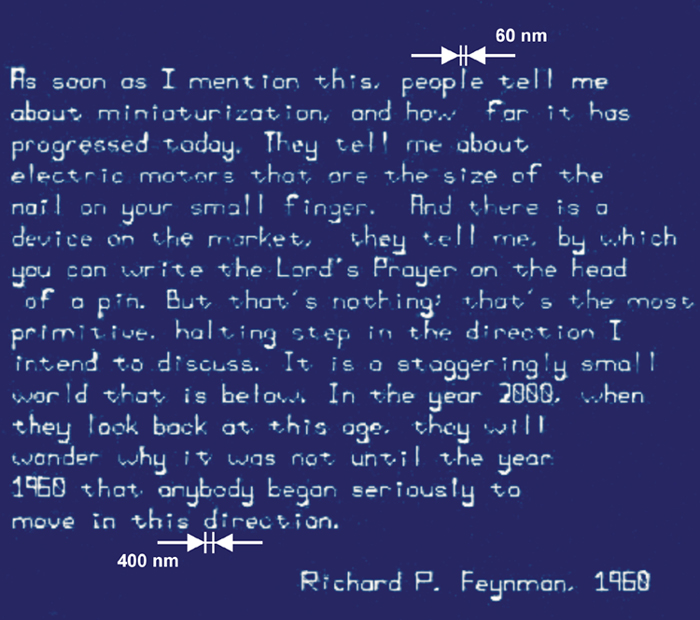
It was 50 years ago today, in a speech to the American Physical Society at Caltech entitled “There’s Plenty of Room at the Bottom,” that Prof. Richard Feynman entered the domain of successful prophets, a small circle typically reserved for biblical personalities.  In this singular oration, Feynman discussed topics that were somewhat fantastic in the middle of the 20th century, but would be completely familiar to nanotechnology students of today.  Each of these “predictions” was illustrated using Feynman’s signature back-of-the-envelope estimations.
  • The concepts of electron beam lithography and nanoimprinting (without using those terms) were presented as possible methods for writing the Encyclopedia Britannica on the head of a pin, and later the entire known literary universe in a 35-page pamphlet.
  • The intersection of biology and nanoscale materials, particularly related to information storage within DNA (whose structure was only determined 6 years earlier), and the use of imaging tools for cellular analysis, were noted as areas ripe for research. 
  • Both determination of chemical structure using new imaging tools (see my post from Sept. 11, 2009 for a recent demonstration of this prediction) and ultimately atom-by-atom chemical synthesis were both described.
  • Prof. Feynman described a variety of nanomachines (automobiles, computers, and biomedical devices) that surely inspired Eric Drexler in his thinking.  In addition, he realized that nanoscale material properties (electrical, magnetic, and mechanical) would deviate from the bulk, and need to be considered by nano-engineers.  While some of the practicalities remained elusive to Feynman, he noted that “there is nothing that I can see in the physical laws that says the…elements cannot be made enormously smaller than they are now. In fact, there may be certain advantages.”
  • While likely unaware of the fact that he was describing a new branch of interdisciplinary science, Prof. Feynman understood the need for educational initiatives to motivate students to potential careers in this field, and specifically called for high school competitions.  In addition, he offered two prizes for experimental demonstrations of the concepts he illustrated: one for a miniature motor, which was claimed 4 months later, and a second for reproducing a page of text at 1/25,000 scale.  The latter was won by a Stanford graduate student in 1985 who used electron beam lithography to print the first page of Dickens’ A Tale of Two Cities on a page measuring only 6.25 microns per side.
  • Finally, while remaining a theoretical physicist, Prof. Feynman was thinking like an early entrepreneur well before the Bayh-Dole act opened the doors for universities to retain ownership of their intellectual property.  He recognized that “this field is not quite the same as the others in that it will not tell us much of fundamental physics… [but] it would have an enormous number of technical applications.”
It can be argued that “nano-technology” was born and named by Taniguchi in 1974, and reached adulthood (but not maturity) in 1993 with IBM’s quantum corral. I think nobody will disagree that today we celebrate the 50th anniversary of its conception in the fertile mind of Prof. Richard Feynman. 

Note:  For an example of the speech’s text printed using nanoscale letters with dip-pen nanolithography, click here.

Friday, December 11, 2009

I'm Sensing a Trend

This time of year and the end of the decade often inspire list creation.  Examples of this activity include critics' top movie and music picks, as well as Time magazine's lists of everything, including the top ten scandals and the top ten blogs (I guess I am out).

So it was with some skepticism that I read about The Times (of London, not New York) Higher Education Supplement posting its list of the "Top Ten Chemists" of the last decade, as determined by citations per paper from the Thomson Reuters Essential Science Indicators. The "top chemist" (and we can debate the label based on citations, but that is another discussion) is Stephen Buchwald (MIT) with 171 papers and nearly 87 citations per paper.  Two of the other top ten are also organic chemists, including Nobel Laureate (2005) Robert Grubbs (Cal Tech).  This is excellent, and I congratulate these men (for all the top ten are men - again, this is another discussion).  But the truly remarkable aspect of this list (or is it?) is that the remaining 7 chemists all work in the nanoscience and nanotechnology arena.  With more than 1100 publications in the decade combined, these chemists include such well-known names as Chad Mirkin (Northwestern), George Whitesides (Harvard), and Georgia Tech's own Mostafa El-Sayed who comes in at #4 on the list with 112 papers and more than 75 citations per paper.

The fact that nanoscience is playing such a significant role in chemistry research, and the corollary that nanoscience research is dominated by the fields of chemistry, physics and their cousin materials science, is not news to Alan Porter and Jan Youtie who this past fall published an analysis of nanotechnology publication and citation data.  While nanoscience is certainly interdisciplinary (as is much of non-nano science these days), and there is neighborly sharing and borrowing of information and techniques, still there is considerable "local" character as well.

Are these observations characteristic of the ever changing nature of the research environment, or rather an artifact due to labeling and re-labeling of research areas using in vogue terminology to ensure optimum exposure and funding.  Will this be a long-lasting condition, or will the next research and technology revolution quickly replace it?  Only time will tell.

Thursday, December 3, 2009

What Defines a Revolution?

Back in May, I wrote a blog post on the commercial uses of nanotechnology.  I was supportive of an editorial in Nature Nanotechnology (January 2009), titled "The Other Nanotech" which argued that current uses of nanoscience and nanoengineering, while for the most part mundane and low tech (sunscreen and anti-bacterial socks), are providing a framework for more advanced applications later on.

In a recent (November 2009) issue of ACS Nano, Associate Editor Jillian Buriak presents an editorial (it seems like nanotechnology inspires more editorializing than any science I can remember) called "The Quiet Revolution".  In this piece, she laments the fact that most commercial uses of nanoscience have been in the creation of common consumer products, vide supra, and that there is no "killer app" or revolutionary technology yet available.  On the other hand, she postulates that the ultimate revolutionary aspect of nanotechnology is that it has brought a variety of disciplines from international collaborators together to solve important problems from the ground up, and that this may be nanotechnology's long-lasting legacy.

Even though I found myself nodding in agreement with most of the editorial, I felt compelled to respond to Dr. Buriak.  Here is the text of an e-mail I wrote her:

"I read your recent editorial, “A Quiet Revolution”.  Although I agree with your conclusions, that nanoscience is fostering a new kind of inter- and multi-disciplinary environment that is eager to tackle the hard problems of energy, environment, and health, I also think you might take a look (if you haven’t already) at a recent (Jan. 2009) editorial in Nature Nanotechnology (attached).  As this editorial argues, and that I have supported in several of my blog posts, we should embrace the mundane uses of nanotechnology (the sunscreen and anti-bacterial silver nanoparticles) as the lessons learned from these initial commercial ventures will ultimately (and hopefully) be used to create the more ambitious applications (the killer apps).  I would even argue that the electronic circuitry in your iPod Nano is just one of many uses for the nano-sized transistors and other components being developed, and that we often miss the revolutionary nature of technology because the changes occur slowly on the human time scale, but rapidly when put into historical context.  Is nanoscience responsible for all of the societal changes we have witnessed in the last several decades?  Of course not, but it certainly has abetted some major transformations in computers and electronics, and all the things that these touch."

Perhaps we are not in the midst of a technology revolution akin to the industrial revolution or the advent of the computer age.  Rather, to paraphrase former Supreme Court Justice Potter Stewart, we will know the nanotechnology revolution when we see it.

Friday, November 20, 2009

The Great Debate

It appeared in my e-mail in-box innocuously enough.  In the daily media update from the American Chemical Society, there was a notice that the award-winning high school chemistry magazine ChemMatters had created its first video podcast.  This video appears as part of the Bytesize Science programs and is titled "Nanotechnology's Big Impact".  I watched the 7 minute video and was surprised that the applications of nanotechnology highlighted early on were about the creation of autonomous nanobots for medical uses to combat microbial infections from a sore throat to a cut on your toe.  This was followed by a description of "self-assembly" that veered from the typical molecular description of interaction driven monolayer formation to a more sci-fi version (straight out of Michael Crichton's novel "Prey") of self-reproducing "nanomachines".

This concept brought to mind something I have been thinking about recently -- the 2003 "debate" between Eric Drexler, formerly of the Foresight Institute, and the late Rick Smalley, 1996 Nobel Laureate in chemistry and professor at Rice University.  In the "Point-Counterpoint" originally published in Chemical and Engineering News (Dec. 1, 2003), these two great thinkers sparred over the future of nanotechnology and how best to inspire the public as to its benefits, while not overly hyping both the promises and the uncertainties.  Drexler is convinced that molecular assemblers will be able to create an infinite variety of nanomachines by controlled placement of atoms using specific chemical reactions.  At the same time, Drexler is the author of the influential nanotechnology text "Engines of Creation" (1986) which postulates that such machines have the potential to drastically alter the earth and life on it, and in fact coined the term “gray goo”.  Smalley counters with chemical logic that argues against such assembly, and ends the debate by relating the already developing apprehension among middle and high school students that nanobots are a realistic threat and that fear-mongering of this sort is an impediment to progress.  As impassioned as the argument was in writing, I don't think either man was convinced by the words of his opponent.

The fear of run-away nanobots, while extreme, is just one of the reasons why so much attention has been paid to creating a nano-literate public (see many of my earlier posts), proceeding with openness about research results, and addressing the societal and ethical impacts (SEI) of a nano-enabled world.  Many have expressed the notion that there would be a considerable loss to science and society if nanotechnology becomes the next genetically modified organisms (GMO), referring to the technology that has been stifled due to public misunderstanding and fear.  On the other hand, a recent editorial in Nature Nanotechnology ("Keeping the public under the microscope", Vol. 4, No. 11, November 2009) relates that while only 31% of survey respondents have heard about nanotechnology (about the same as 5 years earlier), there is little anxiety among the uninformed and that "twice as many people think that the benefits will outweigh the risks" and “public attitudes…remain open to the guidance of sound science.”

Perhaps Rick Smalley won that debate after all.