Tuesday, April 13, 2010

DIY

In the nearly three years that I have been a technical liaison for the Nanotechnology Research Center (NRC), I have spoken to hundreds and perhaps thousands of potential users of our facility, as well as other interested individuals including students, teachers, scientists, professors, businessmen, alumni, and potential donors.  These interactions have become even more common since the Marcus Nanotechnology Building was dedicated nearly one year ago.  I don’t think a week (perhaps even a day) goes by without the presence of some group touring the building, led by myself or one of my NRC colleagues.

For me, one of the common elements of these talks, tours, and general discussions has been my struggle to convey the unique nature of the NRC’s operation.  The concept of an open facility that is available to users from outside its home university is so unusual in my experience and that of those I am speaking with that I have tried to come up with a comparable business that functions using a similar model.  Over the years I have mentioned the do-it-yourself Hobby Shops found on many military bases, and I used to even show a short advertising video that describes a business eerily similar to the NRC if you substitute the terms “cleanroom” for “auto shop” and “processing staff” for “auto mechanic.”  Even the combination of doing your own work or paying for service is preserved.  Still, it was a bit of a stretch.

Now, a recent article in the New York Times titled “Inventors Wanted. Cool Tools Provided.” (4/11/2010) describes TechShop, a do-it-yourself workshop (actually a chain of them) in the San Francisco Bay area that is much closer to the mark.  As described on the TechShop website:
TechShop is a 15,000 square-foot membership-based workshop that provides members with access to tools and equipment, instruction, and a community of creative and supportive people so they can build the things they have always wanted to make.
According to TechShop chief executive Mark Hatch (as quoted in the NYT article):
Making things is core to who we are as Americans. We are inventors. We are creators. Once you give people access to the tools, there will be a resurgence of creativity and innovation.
For a monthly access fee, members can take classes and use the equipment for macro-scale fabrication or use their consulting services for assistance with the work.  Think lathes, milling machines, and welders instead of mask aligners, plasma etchers, and electron microscopes.
You can think of TechShop like a fitness club, but with tools and equipment instead of exercise equipment...TechShop is perfect for inventors, makers, hackers, tinkerers…, and anyone else who wants to be able to make things that they dream up but don't have the tools, space or skills.
I couldn’t have created better marketing copy myself.  If you can understand the appeal and utility of TechShop, then the role filled by the Georgia Tech NRC and the National Nanotechnology Infrastructure Network becomes obvious.

Wednesday, March 24, 2010

Something to Share

I am left speechless by this short film.  I am humbled by it's beauty -- both the simplicity in the natural world around us, and in the skill of the filmmaker that created this representation.  Watch and enjoy.

Nature by Numbers

Tuesday, March 9, 2010

Nano-Potpourri

As an ACS member, I receive Chemical and Engineering News, a weekly magazine.  I usually flip through the issue quickly, looking through awards and obituaries.  But then, instead of reading the rest of the magazine while it is still timely, I usually place it aside until I have amassed a pile consisting of several weeks or months of issues. I brought along several of these back issues to peruse on a recent plane trip, hoping to discover a few items from the world of nanotechnology. I was not disappointed, and in no particular order, this is what I found.

1.  Despite the warnings about the unknown interactions of nanoparticles and human physiology, those who work in this field and who should know better are not taking the minimum precautions necessary when studying these materials.  According to a recent report, up to one-quarter of researchers are not using the proper (or any) protective measures when working with potentially inhalable nanomaterials.  If we don’t want the public to have unnecessary nanophobia, we scientists need to be careful about providing justifiable reasons for these fears.

2.  Although the president’s overall 2011 budget request is flat, it does include a healthy 5.6% increase for non-defense research and development.  However, specific interagency funding for the National Nanotechnology Initiative (NNI) stayed constant, with only a 0.1% increase from 2010 to 2011.  If you dig deeper, however, you see that large increases in nanotechnology funding will occur in energy (DOE), life sciences (NIH and FDA), and environment (EPA).  This is being offset by decreases to defense, NSF, and NIST nanotechnology funding.  Much of the increased money will go to research on the environmental, health, and safety aspects of nanotechnology (see above).

3.  The NNIN education office at Georgia Tech is considering the purchase of a table-top scanning electron microscope.  As part of the selection process, Nancy Healy has looked at several potential models and recently showed me some amazing pictures of butterfly wings and magnesium crystalline material.  I was awed by nature’s beauty which lies so close yet is hidden and impossible to see until revealed by electron beam technology.  If your reaction to these images is the same as mine, then you will want to purchase a new coffee-table book, No Small Matter: Science on the Nanoscale, by Felice Fankel and George Whitesides, which was recently reviewed in C&ENews.  My birthday is still many months away, but this book is on my wish list.

Tuesday, March 2, 2010

What a Show

Last Thursday night the Nanotechnology Research Center put on quite a production.  More than 20 Georgia Tech (NRC and EII) individuals, along with another 10 from some local NRC user companies, collaborated to host a Field Trip for the Technology Association of Georgia (TAG) at the Marcus Nanotechnology Building.  After a welcome by TAG President Tino Mantella and an introduction by NRC Director Dr. Jim Meindl, the nearly 80 guests had opportunities to explore five areas of nanotechnology, from research to commercialization.

A behind-the-scenes tour of the Marcus building showed the attendees what is so unique about the cleanroom and its supporting infrastructure, and how this is important for conducting research at the nanoscale.  Since the visitors could not go into the cleanroom, a live audio/video link was used to conduct a demonstration of photolithographic pattern transfer, one of the key steps in fabrication.  We were able to demonstrate some advanced imaging tools, atomic force microscopy and scanning electron microscopy (thanks to Hitachi), which allow researchers to study and measure samples with nanometer resolution.  Attendees also had an opportunity to participate in some hands-on activities used in nano-education and outreach and to examine nano-enabled commercial products.  In addition, exhibitors from Axion Biosystems, NanoGrip Technologies, Claro Chemical, nGimat, and OpenCell were on hand to explain their technologies and showcase their prototypes or products to the assembled technology professionals.


Five groups of attendees rotated among the stations with clock-work precision, aided by able tour guides.  Even though some of the lighting went out early on in the evening, the enthusiasm of both guests and hosts was not dimmed.  As the formal program came to an end, the house lights came on just in time for a reception and additional networking.  Everyone, hosts and guests alike, departed feeling enlightened and pleased with the performance.

Tuesday, December 29, 2009

Happy Anniversary Prof. Feynman

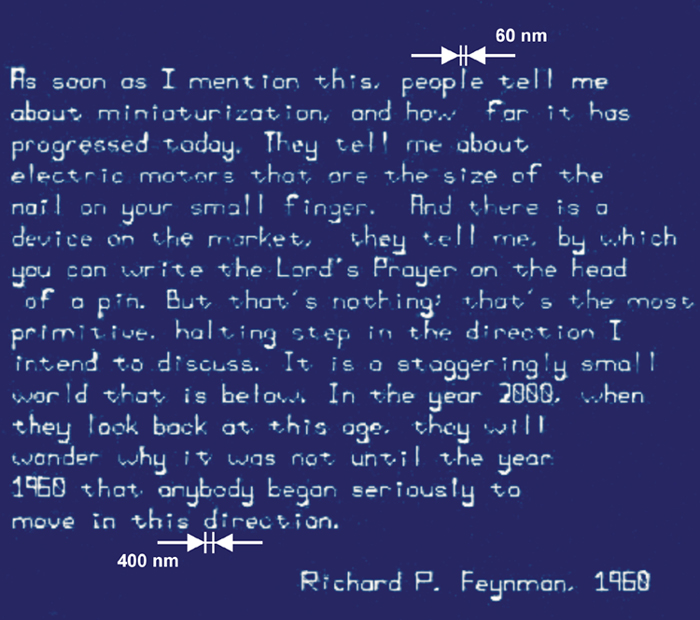
It was 50 years ago today, in a speech to the American Physical Society at Caltech entitled “There’s Plenty of Room at the Bottom,” that Prof. Richard Feynman entered the domain of successful prophets, a small circle typically reserved for biblical personalities.  In this singular oration, Feynman discussed topics that were somewhat fantastic in the middle of the 20th century, but would be completely familiar to nanotechnology students of today.  Each of these “predictions” was illustrated using Feynman’s signature back-of-the-envelope estimations.
  • The concepts of electron beam lithography and nanoimprinting (without using those terms) were presented as possible methods for writing the Encyclopedia Britannica on the head of a pin, and later the entire known literary universe in a 35-page pamphlet.
  • The intersection of biology and nanoscale materials, particularly related to information storage within DNA (whose structure was only determined 6 years earlier), and the use of imaging tools for cellular analysis, were noted as areas ripe for research. 
  • Both determination of chemical structure using new imaging tools (see my post from Sept. 11, 2009 for a recent demonstration of this prediction) and ultimately atom-by-atom chemical synthesis were both described.
  • Prof. Feynman described a variety of nanomachines (automobiles, computers, and biomedical devices) that surely inspired Eric Drexler in his thinking.  In addition, he realized that nanoscale material properties (electrical, magnetic, and mechanical) would deviate from the bulk, and need to be considered by nano-engineers.  While some of the practicalities remained elusive to Feynman, he noted that “there is nothing that I can see in the physical laws that says the…elements cannot be made enormously smaller than they are now. In fact, there may be certain advantages.”
  • While likely unaware of the fact that he was describing a new branch of interdisciplinary science, Prof. Feynman understood the need for educational initiatives to motivate students to potential careers in this field, and specifically called for high school competitions.  In addition, he offered two prizes for experimental demonstrations of the concepts he illustrated: one for a miniature motor, which was claimed 4 months later, and a second for reproducing a page of text at 1/25,000 scale.  The latter was won by a Stanford graduate student in 1985 who used electron beam lithography to print the first page of Dickens’ A Tale of Two Cities on a page measuring only 6.25 microns per side.
  • Finally, while remaining a theoretical physicist, Prof. Feynman was thinking like an early entrepreneur well before the Bayh-Dole act opened the doors for universities to retain ownership of their intellectual property.  He recognized that “this field is not quite the same as the others in that it will not tell us much of fundamental physics… [but] it would have an enormous number of technical applications.”
It can be argued that “nano-technology” was born and named by Taniguchi in 1974, and reached adulthood (but not maturity) in 1993 with IBM’s quantum corral. I think nobody will disagree that today we celebrate the 50th anniversary of its conception in the fertile mind of Prof. Richard Feynman. 

Note:  For an example of the speech’s text printed using nanoscale letters with dip-pen nanolithography, click here.

Friday, December 11, 2009

I'm Sensing a Trend

This time of year and the end of the decade often inspire list creation.  Examples of this activity include critics' top movie and music picks, as well as Time magazine's lists of everything, including the top ten scandals and the top ten blogs (I guess I am out).

So it was with some skepticism that I read about The Times (of London, not New York) Higher Education Supplement posting its list of the "Top Ten Chemists" of the last decade, as determined by citations per paper from the Thomson Reuters Essential Science Indicators. The "top chemist" (and we can debate the label based on citations, but that is another discussion) is Stephen Buchwald (MIT) with 171 papers and nearly 87 citations per paper.  Two of the other top ten are also organic chemists, including Nobel Laureate (2005) Robert Grubbs (Cal Tech).  This is excellent, and I congratulate these men (for all the top ten are men - again, this is another discussion).  But the truly remarkable aspect of this list (or is it?) is that the remaining 7 chemists all work in the nanoscience and nanotechnology arena.  With more than 1100 publications in the decade combined, these chemists include such well-known names as Chad Mirkin (Northwestern), George Whitesides (Harvard), and Georgia Tech's own Mostafa El-Sayed who comes in at #4 on the list with 112 papers and more than 75 citations per paper.

The fact that nanoscience is playing such a significant role in chemistry research, and the corollary that nanoscience research is dominated by the fields of chemistry, physics and their cousin materials science, is not news to Alan Porter and Jan Youtie who this past fall published an analysis of nanotechnology publication and citation data.  While nanoscience is certainly interdisciplinary (as is much of non-nano science these days), and there is neighborly sharing and borrowing of information and techniques, still there is considerable "local" character as well.

Are these observations characteristic of the ever changing nature of the research environment, or rather an artifact due to labeling and re-labeling of research areas using in vogue terminology to ensure optimum exposure and funding.  Will this be a long-lasting condition, or will the next research and technology revolution quickly replace it?  Only time will tell.

Thursday, December 3, 2009

What Defines a Revolution?

Back in May, I wrote a blog post on the commercial uses of nanotechnology.  I was supportive of an editorial in Nature Nanotechnology (January 2009), titled "The Other Nanotech" which argued that current uses of nanoscience and nanoengineering, while for the most part mundane and low tech (sunscreen and anti-bacterial socks), are providing a framework for more advanced applications later on.

In a recent (November 2009) issue of ACS Nano, Associate Editor Jillian Buriak presents an editorial (it seems like nanotechnology inspires more editorializing than any science I can remember) called "The Quiet Revolution".  In this piece, she laments the fact that most commercial uses of nanoscience have been in the creation of common consumer products, vide supra, and that there is no "killer app" or revolutionary technology yet available.  On the other hand, she postulates that the ultimate revolutionary aspect of nanotechnology is that it has brought a variety of disciplines from international collaborators together to solve important problems from the ground up, and that this may be nanotechnology's long-lasting legacy.

Even though I found myself nodding in agreement with most of the editorial, I felt compelled to respond to Dr. Buriak.  Here is the text of an e-mail I wrote her:

"I read your recent editorial, “A Quiet Revolution”.  Although I agree with your conclusions, that nanoscience is fostering a new kind of inter- and multi-disciplinary environment that is eager to tackle the hard problems of energy, environment, and health, I also think you might take a look (if you haven’t already) at a recent (Jan. 2009) editorial in Nature Nanotechnology (attached).  As this editorial argues, and that I have supported in several of my blog posts, we should embrace the mundane uses of nanotechnology (the sunscreen and anti-bacterial silver nanoparticles) as the lessons learned from these initial commercial ventures will ultimately (and hopefully) be used to create the more ambitious applications (the killer apps).  I would even argue that the electronic circuitry in your iPod Nano is just one of many uses for the nano-sized transistors and other components being developed, and that we often miss the revolutionary nature of technology because the changes occur slowly on the human time scale, but rapidly when put into historical context.  Is nanoscience responsible for all of the societal changes we have witnessed in the last several decades?  Of course not, but it certainly has abetted some major transformations in computers and electronics, and all the things that these touch."

Perhaps we are not in the midst of a technology revolution akin to the industrial revolution or the advent of the computer age.  Rather, to paraphrase former Supreme Court Justice Potter Stewart, we will know the nanotechnology revolution when we see it.